
Resources ·
BDU Survey on Public Tenders: If You Want Quality, You Need Up-to-Date Profiles
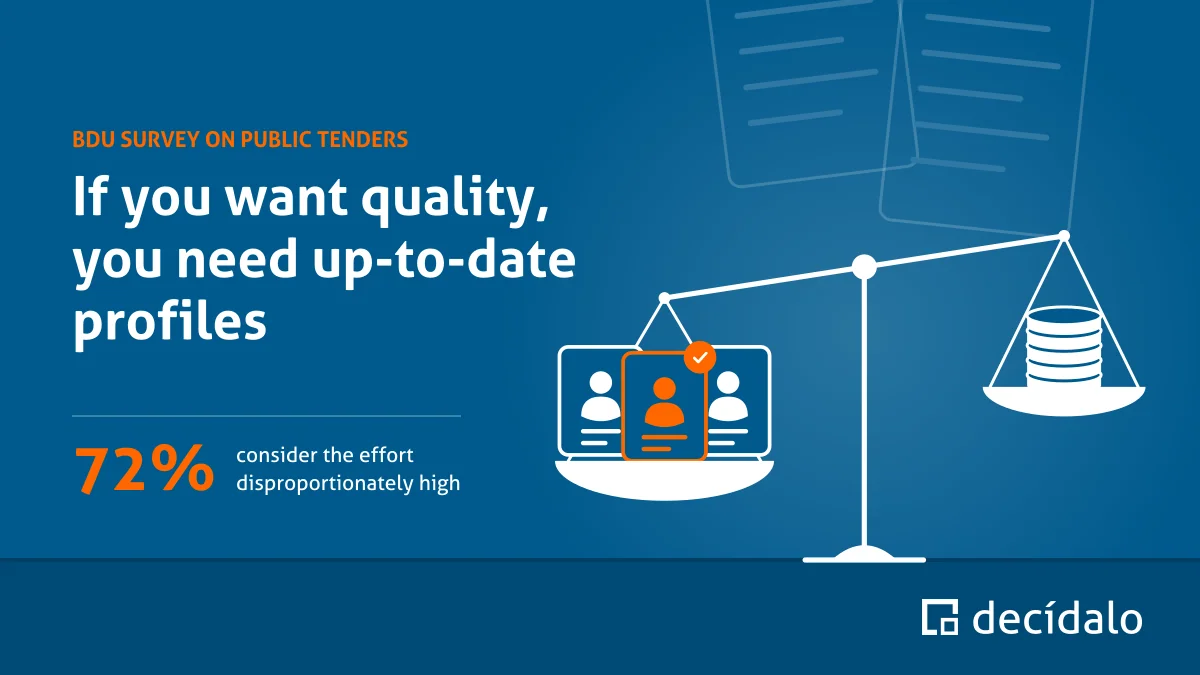
On October 22, 2026, the German Association of Management Consultancies (BDU) published a survey on public procurement. Of the 80 consultants surveyed, 72% consider the formal effort disproportionately high. The gist of the answers: too much red tape and too much weight on price.
Jörg Sarnes, board member of the BDU’s public sector division, sums it up: current procurement procedures are not suited to getting the best value out of consulting (our translation).
Many of our customers regularly bid on public tenders. We see what the survey describes up close: tight deadlines, long profile forms and the hunt for references sitting somewhere on a shared drive. So here is how we read the results.
The BDU survey in numbers
Where we agree with the BDU
As the most important improvement, respondents want qualitative criteria to carry more weight. We see it the same way. Buying consulting mainly by day rate doesn’t necessarily get you the team best suited to deliver the project.
We also share the second demand: 62% want fewer formal documents, and 61% feel that public clients don’t make enough use of the flexibility procurement law offers to simplify things. Every document that adds nothing to the decision costs both sides time.
The BDU is also right about the barriers for small and midsize firms. Respondents name high requirements for revenue, company size or headcount and extensive reference requirements as the biggest obstacles. Specialized firms with exactly the right experience can fail at the eligibility stage as a result.
What we would like to add
In consulting, quality depends on the people who do the work. So when contracting authorities give quality more weight, they mainly look at the proposed team. German procurement law explicitly allows them to score the organization, qualifications and experience of the assigned staff when it can significantly affect the quality of the work (Section 58 (2) VgV).
For that score to mean anything, authorities have to make sure the people they scored actually work on the project. Tender documents therefore usually state that a replacement is only possible with an equivalent person and with the client’s consent. If you propose a team, you have to be able to deliver it.
For consulting firms, the effort doesn’t get smaller, it just moves somewhere else. Instead of documents on company size, it’s about profile forms with mandatory and optional criteria, projects with dates and roles, and references with contact persons. And the people behind them have to be available when the project starts.

What this looks like in practice
Take an IT consulting firm with 150 employees. A German state agency tenders a three-year framework contract, with 60% of the award based on quality. It asks for five profile forms in its own template and three reference projects from the past three years. Submission deadline: three weeks.
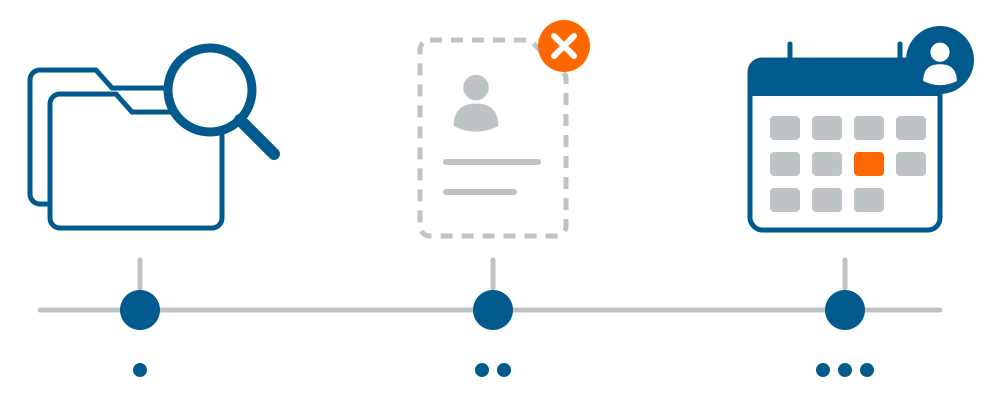
Week 1
The bid team looks for the right people in old proposals, on shared drives and by asking business unit leads.
Week 2
A perfect reference project gets dropped because its dates and roles were never documented.
Week 3
The senior architect with the strongest profile turns out to be booked from spring, right when the project starts.
We see this a lot: the right team is there, but the documents behind it are scattered or out of date, and in the end time runs out.
What consulting firms can control
When the BDU’s demands will show up in procurement practice is largely out of consulting firms’ hands. What they can do is make sure profiles, project experience, certifications and references are up to date and easy to find before the next tender arrives. Most of it already exists in every firm, just spread across many places.
decídalo keeps your people’s skills, project experience, certifications and availability in one place. For the tender in our example, that means:
Spot tenders early
decídalo imports tenders from platforms such as TED and Simap.ch and automatically creates leads for those that fit your company profile. So the three weeks don’t start only when someone happens to come across it.
Find the right team
Who has public sector experience, who holds the required certifications? The search takes minutes instead of days, with availability for the start date right next to it. Via MCP, you can also ask Claude, Copilot or ChatGPT.
Get profiles into shape
Proposal CVs are generated from profile data at the push of a button, in your templates. The Microsoft Office add-in lets you fill tender documents directly, with a few clicks instead of hours of copy-paste in Word.
Back it up with references
decídalo suggests matching project references for the tender, including ones that never made it into an earlier proposal. Firms that record completed projects with dates, roles and outcomes have more to choose from at the next bid.
For our example, this means the bottleneck with the senior architect would have shown up on day one, leaving the bid team enough time to propose an equally qualified colleague who is free at project start.
For the full path from tender to submission, read our article From RFP to Proposal in Hours, Not Weeks.
Our conclusion
We share the BDU’s view, especially on the weight of quality and the amount of formal paperwork. In our view, standardized profile forms would also help. Today, many contracting authorities ask for the same information in their own templates, and reformatting costs time that would be better spent on the actual concept.
Our advice to consulting firms: don’t wait for reform. Firms that keep profiles and references up to date today benefit at every tender, and even more so once quality counts for more. To see how AI helps with reading tenders, try our free tender assistant.
Source of the survey figures and the quote: BDU press release of October 22, 2026, survey of 80 consultants from June 8 to 26, 2026.