

Resources · · 6 min read
Project Start Delayed: Plan Bench and Pipeline Together
In late October 2026, Infosys and Cognizant, two large international IT service providers based in India and the US, lowered their growth outlook for the year. Among other reasons, Cognizant said macroeconomic uncertainty is putting pressure on clients’ discretionary spending. In Germany, too, the mood is subdued: in the business climate index of the German consulting association BDU for the third quarter of 2026, IT consulting lost 1.8 points and now stands at 88.
What shows up in quarterly reports as cautious clients often looks like a delayed project start in a consulting firm’s day-to-day. The client has said yes, the team is set, the start date is October 1. Three weeks before, an email arrives saying budget approval is taking longer. New date: sometime in January, maybe.
And then the question is what happens to the five people who were blocked for October.

What a delay like this costs
Let’s say you manage to place all five on other projects after 6 weeks. At a daily rate of €1,100, that is still €165,000 in revenue you will not make up.
It can get expensive a second time: once those five are staffed elsewhere, they are missing when the client suddenly wants to start in December after all. Then you bring in contractors, or the start slips a second time, this time because you can’t deliver.
Losses like these hit an industry that already bills little: worldwide, consulting and services firms bill less of their working time than at any point since the SPI benchmark began 19 years ago.
Billable utilization
Run the numbers for your firm
Take the delayed project starts of the past 12 months. For each one, note how many people were planned, how many working days they then spent without an assignment and at what daily rate. The total is your revenue loss from delays. Add the cost of contractors you had to bring in because your own people were no longer available. If you lack the data, start with the last three delays you can remember.
Where it usually breaks down
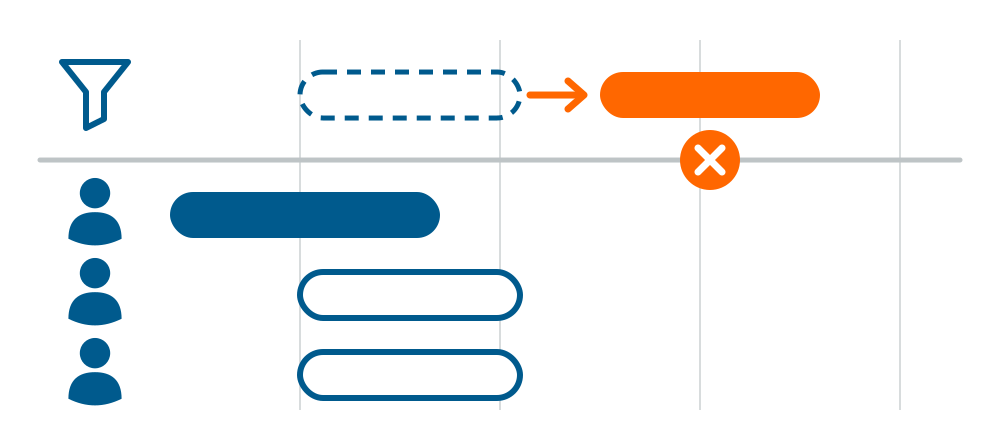
Sales often notices early that a project is shaky. But that information sits in the CRM or in the account manager’s head, not in resource planning. Many firms plan resources in a separate Excel sheet and only learn about the delay once it is final. The other way around, sales cannot see who becomes available when, so they cannot look for projects to fill the gap.
Checklist
Warning signs that are often there weeks ahead
- Budget approval has been promised verbally but is not yet in writing.
- There is no date for the kickoff yet.
- The contract has been sitting with procurement or legal for weeks.
- The client’s contact person or project sponsor changes.
- The client asks for a smaller scope or, “just to be safe,” a later start.
Record these signs in the opportunity so resource planning can see them.
What helps in practice
Plan early, but mark it as a reservation
Anyone planned for a proposal should show up in planning before the contract is signed. Everyone needs to see that it is a reservation, not a firm booking. Otherwise an uncertain project blocks people who are needed elsewhere.
Decide how long you wait
Decide in advance how long people stay reserved for an uncertain opportunity and who decides to release the reservation. Otherwise every account manager holds on to their people for as long as they possibly can. For example: if the contract isn’t signed 2 weeks before the planned start, the head of delivery decides whether the reservation stays.
Template
The weekly meeting: 30 minutes, 4 questions
Attendees are the sales leads and whoever plans resources. Ideally, both look at the same list.
- Who becomes available in the next 8 weeks?
- Which opportunities could start in that time, and how certain is the date?
- Where has a start date moved since last week?
- Who takes care of which gap before the next meeting?
What people can usefully do in the meantime, from certifications to helping with proposals, is covered in our article Bench management in IT consulting.
What you can agree with the client
Some things can be settled with the client in the proposal:
- Set out until when the client can move the start without consequences. After that, the proposed team is no longer guaranteed.
- Agree on a start window, such as “start between October 1 and 15.” That is easier to plan than a fixed day that then doesn’t hold.
- Start small, for example with an analysis phase for two people. That keeps the project moving while approval for the rest is still pending.
- Build the team in stages: two people at the start, three more a few weeks later. If something slips, less capacity is affected.
How decídalo helps
In decídalo, opportunities, projects, skills and availability are connected. Opportunities come from your CRM, such as Salesforce, Microsoft Dynamics, HubSpot or Pipedrive, and stay in sync. From the pipeline, decídalo determines which skills and capacity you will need in the coming months.
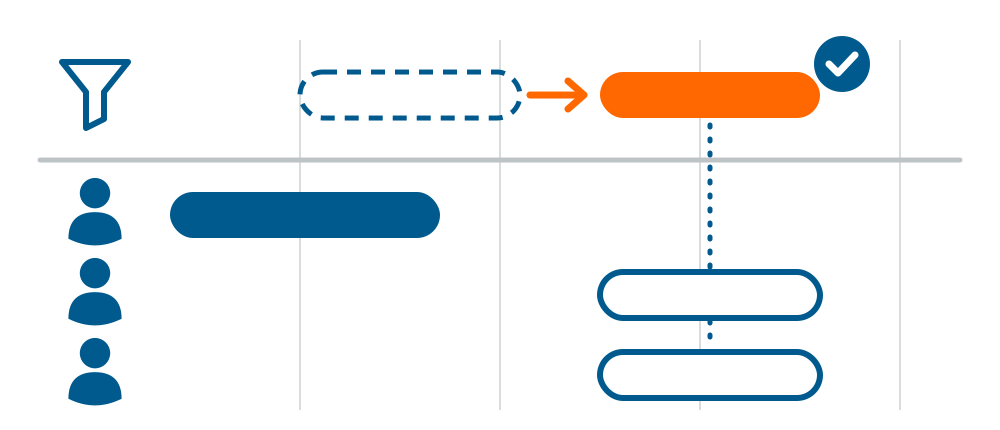
Consultants already planned in a proposal move into resource planning directly when you win. If the client wants to start in December after all, skill search finds suitable people and shows their availability right away. And if someone becomes available earlier than expected, the internal project marketplace shows you open projects that fit them. Employees can also put themselves forward there.
Where to start
Run the numbers on the delays of the past few months and introduce the weekly meeting. Neither needs a new tool, and both quickly show where you are losing revenue today.
If you want to see what this looks like with your own data, book a demo or try decídalo for free.